search this blog

Showing posts with label culture. Show all posts

Thursday, 4 August 2011

Ashanti Strip Weaving - Kente Cloth


Also known as a Kente cloth. Made by the Ashanti people of Ghana and is the most labour intensive weaving in the world. It became a true art form and represented the concept of royalty and status. Traditionally the Ashanti people only worked around geometric patterns. The spider Anansi taught the art of weaving to two brothers who had discovered his web while on a hunting trip. Anansi also taught them how to spin and dye the threads. Since then the Ashanti have used the strip looms Anansi taught them to build. Men traditionally do the strip weaving in West Africa.

Back Strap Loom


In primitive societies it provides a weaving device at very little cost. Even in the more advanced countries it is used. It is very portable. It can be set up and used almost anywhere. The primary feature of the back strap loom is that the lengthwise threads (warp) are stretched from a fixed device such as a post or tree to a belt that a person wears around their waist. By backing away from the post or tree, the user can pull the warp threads into tension. In order to weave, the threads must be stretched in a horizontal direction and a means must be provided so that the threads can be separated into two (or more) parts so that a weft thread can be passed between the two sets of threads. The two sets of warp threads can then be reversed and a weft thread passed through again. By repeating this process, fabric can be woven. Using the backstrap loom, a weaver can produce fabric with a plain weave. Most simply, this is an over-under-over-under pattern.

Ikat Weaving


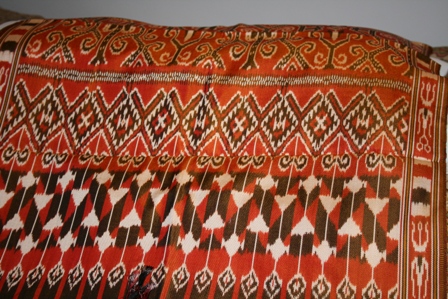
Ikat is the method of weaving that uses a resist dyeing process similar to tie-dye on either the warp or weft fibres. The dye is applied prior to the threads being woven to create the final fabric pattern or design. One of the oldest forms of textile decoration. Ikat weaving styles vary widely. Many design motifs may have ethnic, ritual or symbolic meaning or have been developed for export trade. Traditionally, ikat are symbols of status, wealth, power and prestige. Because of the time and skill involved in weaving ikat, some cultures believe the cloth is imbued with magical powers